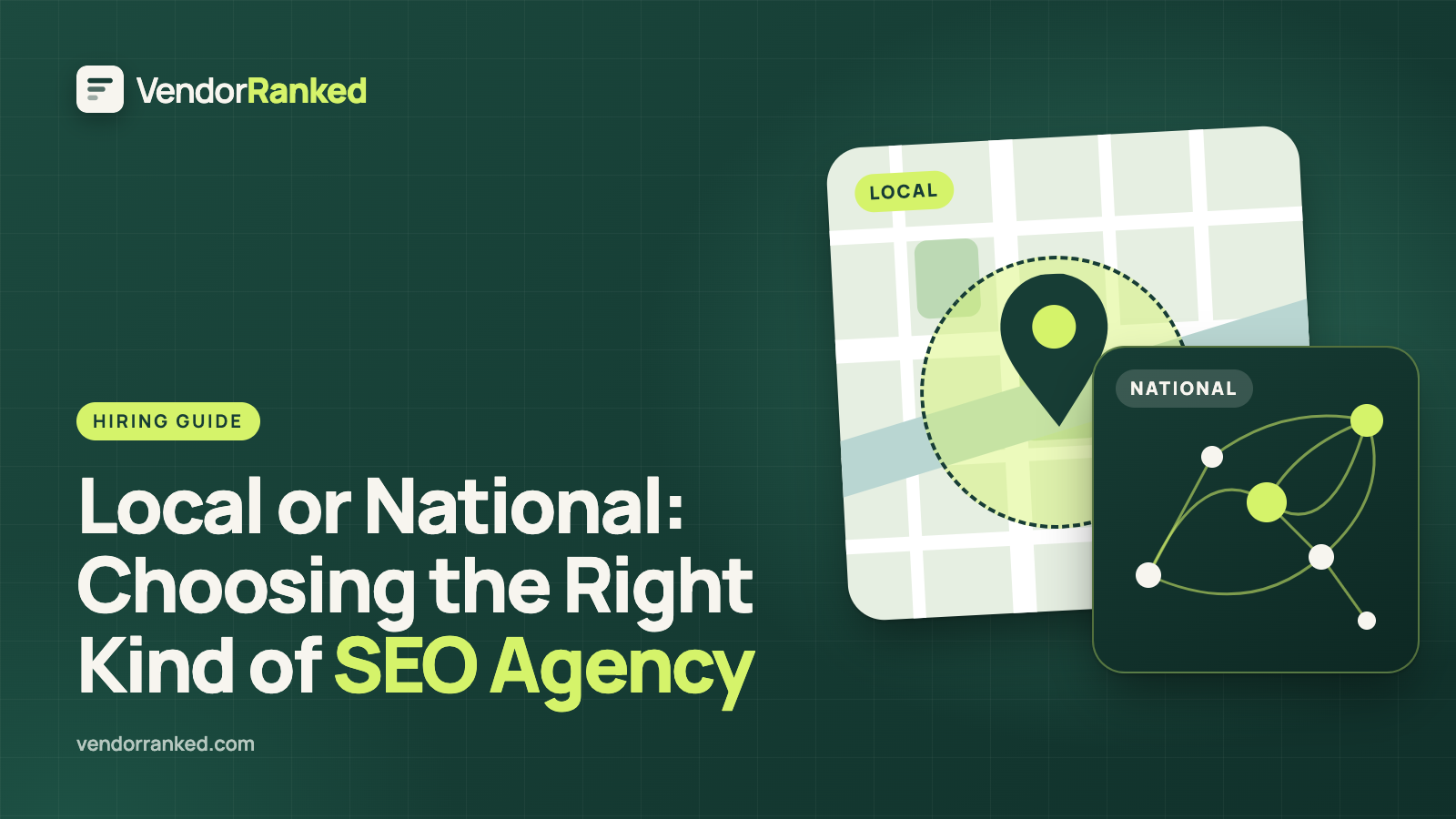
Short answer: Choose a local SEO agency if most of your customers come from a specific city or service area and you depend on map results, reviews and your Google Business Profile. Choose a national agency if you sell across the country, run an e-commerce or software business, or need a large team and heavy content production. What matters more than the agency’s zip code is whether it has done the kind of SEO you need before.
When people say “local agency,” they usually mean one of two different things, and mixing them up is where a lot of bad hiring decisions start.
The first meaning is geography: the agency’s office is in your town or state, and you can meet for coffee. The second is specialty: the agency is skilled at local SEO, the discipline of getting a business to show up when someone nearby searches for a plumber, a dentist or an accountant. A firm in Dallas can be great at local SEO for clients in Seattle. A firm down the street can know nothing about it.
So the real question isn’t “local or national?” It’s two questions: what kind of search do my customers do, and how much help do I need? Let’s take them in order.
First, figure out what kind of search business you are
Ask yourself where your customers are when they find you.
- They’re nearby and searching with a place in mind. Think “roofer near me,” “family dentist in Tempe,” “tax accountant open Saturday.” You’re competing for the map pack and local results.
- They’re anywhere in the country and searching by topic or product. Think “project management software for agencies” or “best running shoes for flat feet.” Location barely matters. You’re competing on content, authority and product pages.
- A mix of both. A regional law firm that also publishes national-level guides, or a multi-location franchise with a central brand.
Your answer decides which skills you’re hiring for, and that matters more than the size of the firm.
How Google decides local results (and why it matters for your hire)
Google says local results are based mainly on three things: relevance (how well your profile matches what someone searched for), distance (how far your business is from the searcher), and prominence (how well known you are, based partly on links, reviews and ratings). Google also says you can’t pay for a better local ranking.
Two takeaways for choosing an agency:
- Distance is out of anyone’s control. An agency can’t make your office closer to the customer. What they can improve is how complete and accurate your profile is and how much trust you’ve built. Anyone promising to “beat the distance problem” deserves a skeptical look.
- Prominence is slow to build. It comes from real reviews, real mentions and a real reputation, so you want people who understand review requests, local citations and relevant local links, not just keyword tweaks.
When a local-focused agency makes sense
A local specialist tends to be the better fit when:
- Most of your revenue comes from a defined service area (a metro, a county, a few cities).
- Your biggest growth lever is the map pack, reviews and your Google Business Profile.
- You’d value someone who knows your market: local directories, local press, chambers of commerce, neighborhood names and how people actually describe where they live.
- You want in-person meetings or a team in your time zone. That’s a real advantage if it matters to you, not a ranking factor.
- Your budget is modest and a large agency’s minimums are out of reach.
The trade-offs are real, too. Smaller agencies can have thinner benches. If your one strategist leaves, the work can stall. They may be strong on local profiles and weaker on technical SEO or content at scale.
When a national agency makes sense
A larger, national firm tends to fit when:
- You sell nationwide, or in many markets, through e-commerce, software or services delivered remotely.
- Your site is large (thousands of pages), has complex technical needs, or is being migrated or redesigned.
- You need many specialists at once: technical, content, analytics, digital PR, development.
- You operate many locations and need consistent processes across all of them.
The trade-offs: higher minimums, more account layers between you and the people doing the work, and less feel for any single market. A national firm that’s good at national content strategy isn’t automatically good at the details of a Google Business Profile in a small city.
Local vs. national at a glance
| Local-focused agency | National agency | |
|---|---|---|
| Best for | Service-area businesses, single or few locations | Nationwide brands, e-commerce, software, big sites |
| Main levers | Business Profile, reviews, citations, local links, location pages | Content at scale, technical SEO, digital PR, analytics |
| Team size | Usually small | Usually larger, with specialists |
| Market knowledge | Often deep in a region | Broad, varies by market |
| Watch for | Thin bench, narrow skill set | Account-manager layers, template work |
Every one of those is a tendency, not a rule. Plenty of small firms have impressive technical depth, and plenty of large ones do excellent local work.
The middle option nobody mentions
It’s possible to hire a remote agency that specializes in local SEO. If your market is something like home services, healthcare or legal, a specialist who works with hundreds of similar businesses may have seen more of your problems than a generalist next door. What you give up is the coffee meeting. What you get is pattern recognition.
The opposite also exists: a local generalist who does web design, social posts and a little SEO on the side. Be honest with yourself about which of those you’re hiring.
Five checks that apply either way
- Ask for examples that look like you. Same type of business, similar size, similar kind of market. Google’s own advice on hiring an SEO starts with asking for examples of past work and experience in your industry and city.
- Ask who owns your Google Business Profile. It should be in your name, with the agency added as a manager.
- Ask how they handle reviews. You want a process for asking real customers for reviews. Fake reviews and buying reviews aren’t a strategy, they’re a risk.
- Ask how they handle service-area pages. Pages for each city you serve can help when each has something real to say. Dozens of near-identical pages with the city name swapped can fall under Google’s rules on scaled, low-value content.
- Ask how they’ll report. Calls, direction requests, form fills and booked jobs. Not only rankings.
Common local SEO problems an agency should catch
A competent local team will check these early:
- Eligibility. Google’s Business Profile rules say profiles must reflect a real physical location. P.O. boxes and virtual offices aren’t eligible. Service-area businesses that travel to customers should hide their address. A “storefront” that’s really a mailbox is a path to suspension.
- Business name. Names with extra keywords or taglines can get a profile suspended.
- Service area. Google’s guidelines say service areas generally shouldn’t extend beyond about two hours’ drive from the base. A listing claiming to cover three states is a warning sign.
- Consistency. Same name, address and phone across the web. Small mismatches add up.
If a proposal suggests tactics that conflict with those rules, that’s worth discussing before you sign. A suspended profile can take a good chunk of your leads with it.
Do you need an agency at all?
Maybe not yet. Google notes that small local businesses can often do much of the basic SEO work themselves, and points to its SEO Starter Guide. Claiming and completing your Business Profile, asking happy customers for reviews and keeping your information accurate costs you time, not agency fees. An agency adds more value when you’ve outgrown the basics, face stiff competition, or simply don’t have the hours.
A short decision guide
- One location, customers within a short drive: start with a local-focused agency or a remote local-SEO specialist.
- A few locations in one region: a regional agency, or a local specialist with a multi-location track record.
- Many locations across states: a national agency with a documented multi-location process, and ask how they keep each market distinct.
- Customers anywhere, selling online: a national agency strong in content and technical work. Local SEO isn’t your game.
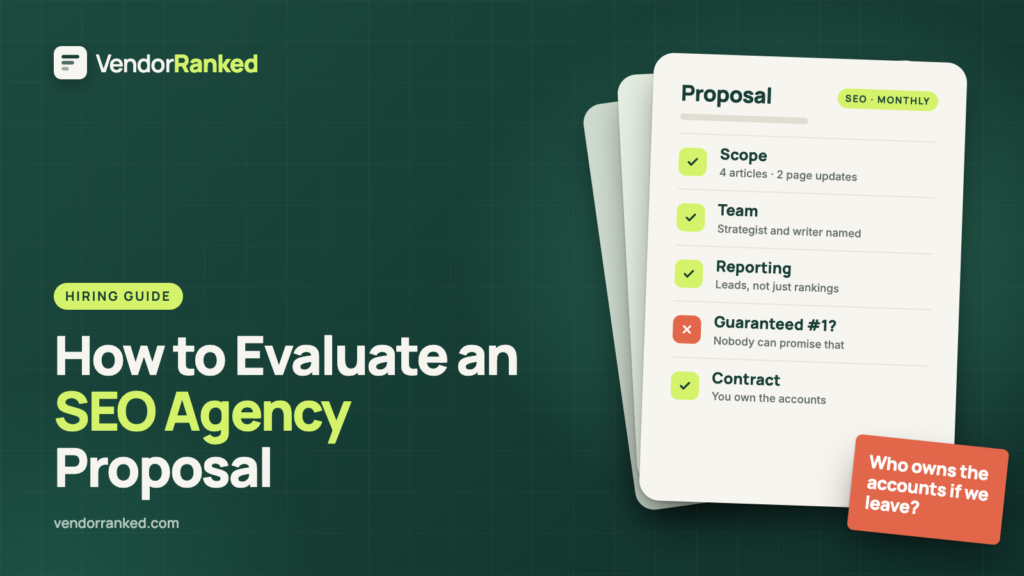
- Not sure: ask two firms of different types for proposals and compare them using our proposal evaluation checklist.
Questions people ask
Is a local SEO agency better than a national one?
Neither is better in general. Local-focused agencies suit businesses that win customers in a defined area. National firms suit businesses that sell broadly or need a large team. Match the agency’s experience to your kind of search, not just its address.
Does the agency need to be in my city?
No. Google ranks your business, not your agency’s location. Being nearby can help with meetings and market knowledge, but experience with businesses like yours matters more.
Can I pay Google for a better local ranking?
No. Google says you can’t request or buy a higher local ranking. Paid ads are separate from the local results, and an agency that implies otherwise is misrepresenting how it works.
What is local SEO?
Local SEO is the work of helping a business appear in search results for people searching in or near a specific place, including the map results. It focuses on the Business Profile, reviews, accurate listings and location-relevant content.
How do I know if an agency is good at local SEO?
Ask for examples from similar businesses, check how they handle your Business Profile and reviews, and confirm they follow Google’s guidelines. Be wary of promises of guaranteed map rankings.
What to do next
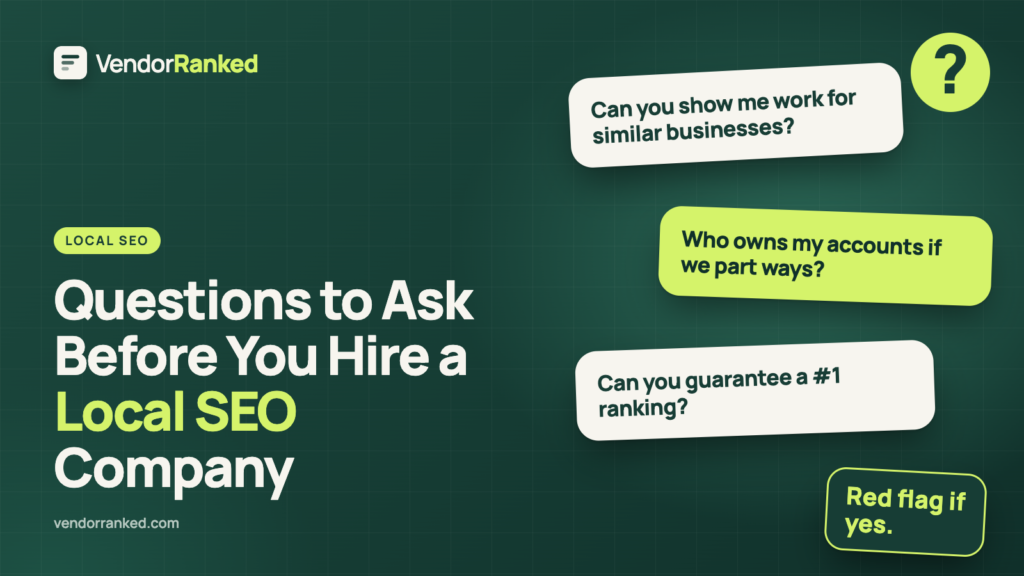
Write down where your customers are and how they search. Then pick one agency of each type and ask them the same questions. Our state rankings list SEO agencies by market so you can see who works in your area, and our questions to ask a local SEO company gives you a ready list for the first call.
Sources
- Google Business Profile Help: Tips to improve your local ranking
- Google Business Profile Help: Guidelines for representing your business
- Google Search Central: Do you need an SEO?
- Google Search Central: Spam policies for Google web search
Last reviewed October 14, 2026. VendorRanked rankings are editorial and are never affected by payment; see our advertising disclosure.