Short answer: To evaluate an SEO agency proposal, check six things: what exactly you get each month, who does the work, whether the plan is built on your site and competitors, how success is measured, what the contract says about ownership and exit, and whether any promise breaks Google’s own rules. If a proposal is vague on even two of those, ask questions before you sign.
Here’s a situation that plays out constantly. You ask three agencies for a proposal. One comes back at a modest monthly fee, one at about double that, and one somewhere in the middle. All three say “SEO” on the cover. All three promise growth. And you’re left staring at a stack of PDFs trying to work out which one is actually the good deal.
The trouble is that SEO proposals aren’t priced like a product with a spec sheet. Two agencies can charge the same and deliver wildly different amounts of work, and a cheap-looking proposal can turn out to be the expensive one once you realize half of what you need isn’t in it. So before you compare prices, you compare contents. That’s what this guide is for.
It’s written for owners and marketing leads in the U.S. who aren’t SEO specialists. You don’t need to know what a canonical tag is. You do need to know what to ask. If you’re still building a shortlist, our SEO agencies buyer’s guide and the state-by-state rankings are a good place to start, and our methodology explains how we assess agencies.
1. Look at the scope first: what exactly will they do each month?
The scope section is the heart of any proposal. It should read like a work order, not a brochure. “Ongoing on-page optimization” and “content strategy” are labels, not deliverables. You can’t tell whether they were delivered.
Compare these two lines:
- Vague: “Monthly content creation and link building.”
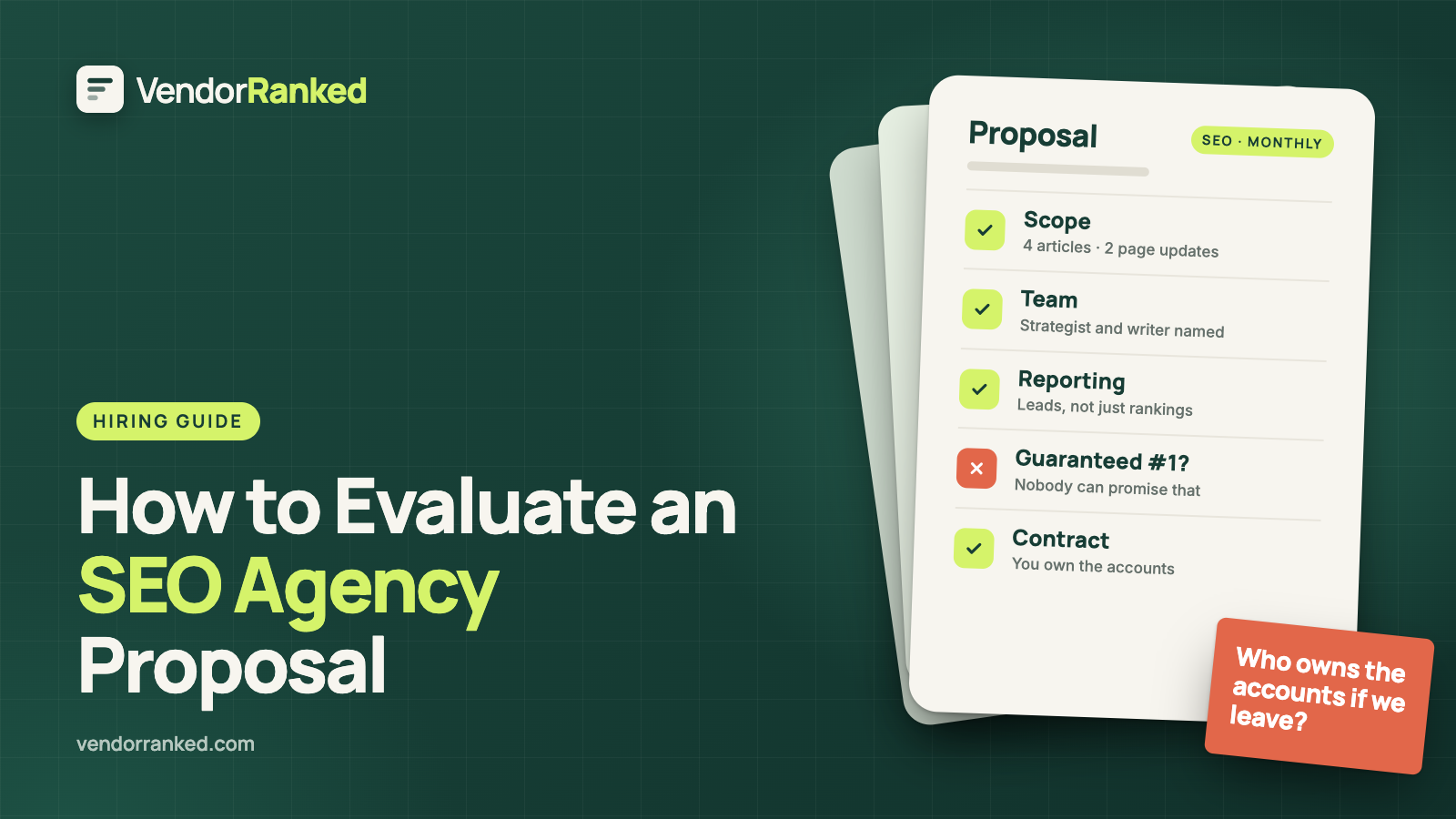
- Specific: “Four new articles per month of roughly 1,500 words each, briefed against agreed keywords and approved by you before publishing; refresh two existing pages; three editorial links or mentions earned from relevant publications.”
The second one can be checked. If month three arrives and you got two articles, you have a conversation to have. With the first, you have an argument about what “creation” means.
Good scopes usually cover three buckets: technical work (crawling, indexing, site speed, fixes to errors), content (new pages and updates to existing ones), and off-site work (how the agency earns links, mentions and local listings). If one bucket is missing, ask why. Sometimes the answer is fine. A site that’s technically clean may not need much technical work. But you want that to be a decision, not an oversight.
2. Who is actually doing the work?
The person who sells you is often not the person who works on your account. That’s normal at most agencies. It only becomes a problem when you can’t find out who the second person is.
Ask for names and roles: who leads strategy, who writes, who handles technical changes, and who you’ll talk to week to week. Then ask the direct question, “Is any of this outsourced or done offshore?” Outsourcing isn’t automatically bad, and plenty of good agencies use freelancers and specialist partners. You just shouldn’t learn about it a year in.
Google’s own guidance for people hiring an SEO makes a similar point: a good one keeps you informed about changes and explains why they’re made. If an agency can’t tell you who touches your site, it’s unlikely they’ll explain what they changed on it.
3. Does the proposal start from your business?
This is the quickest way to tell a custom plan from a template with your logo pasted in. A proposal built for you will mention something that couldn’t apply to anyone else: your competitors by name, a page on your site that’s underperforming, a service line you’d like to grow, the way your customers actually find you.
Google’s guidance describes the same thing from the other side. A good SEO shows interest in what makes your business unique, who your competitors are and how customers find you. If the proposal is built before anyone has asked you a single question about your customers, that’s your answer.
A lightweight audit before the proposal is a good sign. If the agency does want a closer look at your site, note what they ask for. Google says that for an audit you should grant read-only Search Console access, not write access. An agency that wants full admin rights to everything before you’ve signed anything is asking for more than the job needs.
4. What results do they expect, and how soon?
Honest SEO proposals sound a little less exciting than dishonest ones. They talk about ranges, assumptions and time. Google’s page on hiring an SEO is blunt about it: no one can guarantee a number-one ranking on Google, and if someone promises first place, you should find someone else.
That doesn’t mean you should accept “we’ll do our best” either. A good proposal should give you:
- A realistic timeline. SEO generally takes months, not weeks, to show up in traffic and leads, and an agency that promises overnight movement is guessing or selling.
- The assumptions behind it. What has to be true for the forecast to hold (for example, that your developers can implement fixes within a set period).
- The goal in business terms. Leads, calls, booked appointments or sales, not just “better rankings.”
Be careful with any forecast that looks very precise, like “you’ll gain 312 percent more traffic by June.” Nobody has that much visibility into Google’s results, and Google doesn’t share its ranking systems with third parties. Precision isn’t the same as accuracy.
5. How will you know it’s working?
Rankings are one measure, and an easy one to game by picking keywords nobody searches. What you actually care about is whether more of the right people find you and contact you.
Ask what the monthly report contains and request a sample. Good ones tend to include:
- Organic traffic to the pages that matter (not just the home page).
- Leads or conversions from organic search, tracked in a way you can verify yourself.
- What was done this month, and what’s planned next.
- Honest commentary, including what didn’t work.
One test is worth running: ask whether you’ll have your own login to the analytics and Search Console data, or only see screenshots in a PDF. You should be able to look at the raw numbers without asking permission.
6. Read the contract like you might leave
Nobody likes thinking about the breakup during the courtship, but this is the section that matters most if things go wrong. Look for:
- Minimum term and notice period. Month-to-month after an initial period is common. Long lock-ins with big cancellation fees deserve a second look.
- Ownership. Who owns the content written for you, the Google accounts set up for you, the analytics property, and any tools or websites built on your behalf? The safest setup is that they’re in your name from day one.
- What happens to links and assets if you leave. Ask what stays with you and what disappears.
- Access. If they work directly in your CMS or server, ask them to document changes. Google’s guidance says an SEO with that kind of access should explain every change they make.
- Responsibility. Google also reminds site owners that they’re responsible for the actions of the companies they hire. If an agency does something that violates Google’s rules, the penalty lands on your site, not theirs.
7. Check the methods, not just the promises
Ask how the agency earns links and how it produces content at scale. Google’s spam policies are public, and a few things in them are worth knowing before you hire anyone:
- Buying or selling links to influence rankings violates the policy, including trading them for goods, services or free products. Sponsored links are fine when they’re properly marked with
rel='sponsored'ornofollow. - Using automated tools to generate links is a violation.
- Mass-producing pages to manipulate rankings without giving readers anything useful is “scaled content abuse,” whether it’s done with AI or without it.
Sites that break these rules can rank lower or drop out of results. So when an agency says it will “build 200 links a month” or “publish 100 location pages,” that deserves a calm follow-up: how, from where, and what’s on those pages?
Warning signs worth walking away from
- Guaranteed rankings, or a guaranteed result by a specific date.
- A claimed “special relationship” with Google, or a “priority submit.” Google flags both as signs to be careful.
- Secrecy about methods (“proprietary process”) with no explanation of what actually happens.
- A big pile of links for a low fixed price.
- A proposal that arrives before anybody has asked about your business.
- Pressure to sign this week for a “limited discount.”
If you think you’ve been misled by a deceptive SEO firm, Google’s guidance suggests filing a complaint with the Federal Trade Commission.
A quick example: two proposals, same price
Here’s a made-up pair to show how this works in practice. Neither is a real agency.
Proposal A promises “full-service SEO,” top-three rankings in 90 days, 50 backlinks a month and “unlimited optimization.” It has no named team, a 12-month contract and no mention of who owns the content.
Proposal B costs the same. It starts with a review of the client’s top ten service pages, lists six technical fixes in order of priority, commits to four articles and two page updates per month, names the strategist and writer, reports on leads rather than just rankings, runs month to month after three months, and puts all accounts in the client’s name.
Proposal A sounds bigger. Proposal B is the one you can hold someone to. When in doubt, pick the one you can verify.
A simple scorecard you can use
Give each proposal one point for every “yes”:
- Deliverables are listed by month, with numbers.
- The team is named and the role of each person is clear.
- The plan references your site, your competitors and your customers.
- Goals are stated as leads or revenue, with a realistic timeline.
- Reporting is described, you get direct access to your data, and a sample is provided.
- Contract terms are fair, and you own the accounts and content.
- Link and content methods are explained and fit Google’s rules.
- Nothing is guaranteed that nobody could actually guarantee.
Anything under six out of eight needs another conversation before you sign.
Questions people ask about SEO proposals
How many SEO proposals should I get?
Three is a practical number. It’s enough to see how scope and approach differ, and not so many that you’re comparing PDFs for a month.
Should I pick the cheapest proposal?
Not by default, and not the most expensive either. Compare what’s included first. A lower price that leaves out technical work or content you need isn’t a saving.
How long before SEO shows results?
Usually months rather than weeks, and it depends on your site’s starting point, competition and how quickly fixes get implemented. Be wary of anyone who promises a specific date.
Is it a red flag if an agency won’t share its methods?
Yes. A good agency can explain what it does and why in plain English, even if the details of its process are its own. Google’s guidance warns about companies that are vague about what they’ll do.
Should I own my website, content and accounts?
Yes, wherever possible. Put analytics, Search Console and Google Business Profile in your own name and add the agency as a user, so you keep everything if you part ways.
Do I even need an agency?
Maybe not. Google notes that small local businesses can often do much of the basic work themselves with the SEO Starter Guide. Agencies tend to earn their fee on bigger sites, redesigns, competitive markets or when you don’t have the time.
What to do next
Pick your top two proposals, send each the same list of questions from the sections above, and compare the answers side by side. The agency that responds clearly, without defensiveness, is usually a better partner than the one with the slickest deck.
Still choosing between a neighborhood specialist and a national firm? Read Local or National: Choosing the Right Kind of SEO Agency. Ready to talk to someone? Questions to Ask Before You Hire a Local SEO Company gives you a list to bring to the call.
Sources
- Google Search Central: Do you need an SEO?
- Google Search Central: Spam policies for Google web search
Last reviewed October 14, 2026. This is general guidance, not legal advice. VendorRanked rankings are editorial and are never affected by payment; see our advertising disclosure.